
IDesignerLab · Private Residence, Singapore
A home where mid-century warmth and contemporary refinement meet in perfect dialogue, shaped by personal colour, cherished art, and the quiet courage of keeping what matters.
There is a particular kind of courage in designing around what you already love. Not the easy kind — the kind that requires genuine conviction in your own taste, your own memory, your own story. IDesignerLab found exactly this conviction in a Singapore couple who came to them not with a clean slate, but with a richly annotated one: a painting they returned to again and again, a pair of colours that held private meaning, furniture that had survived moves and years and still felt right.
The result is a home that does not announce itself. It accumulates. From the moment you step through the door, something is different — not the scale of the space, which is generous but not extraordinary, but the feeling that every object has been placed with consideration, that nothing is here by accident, that the room knows who lives in it.
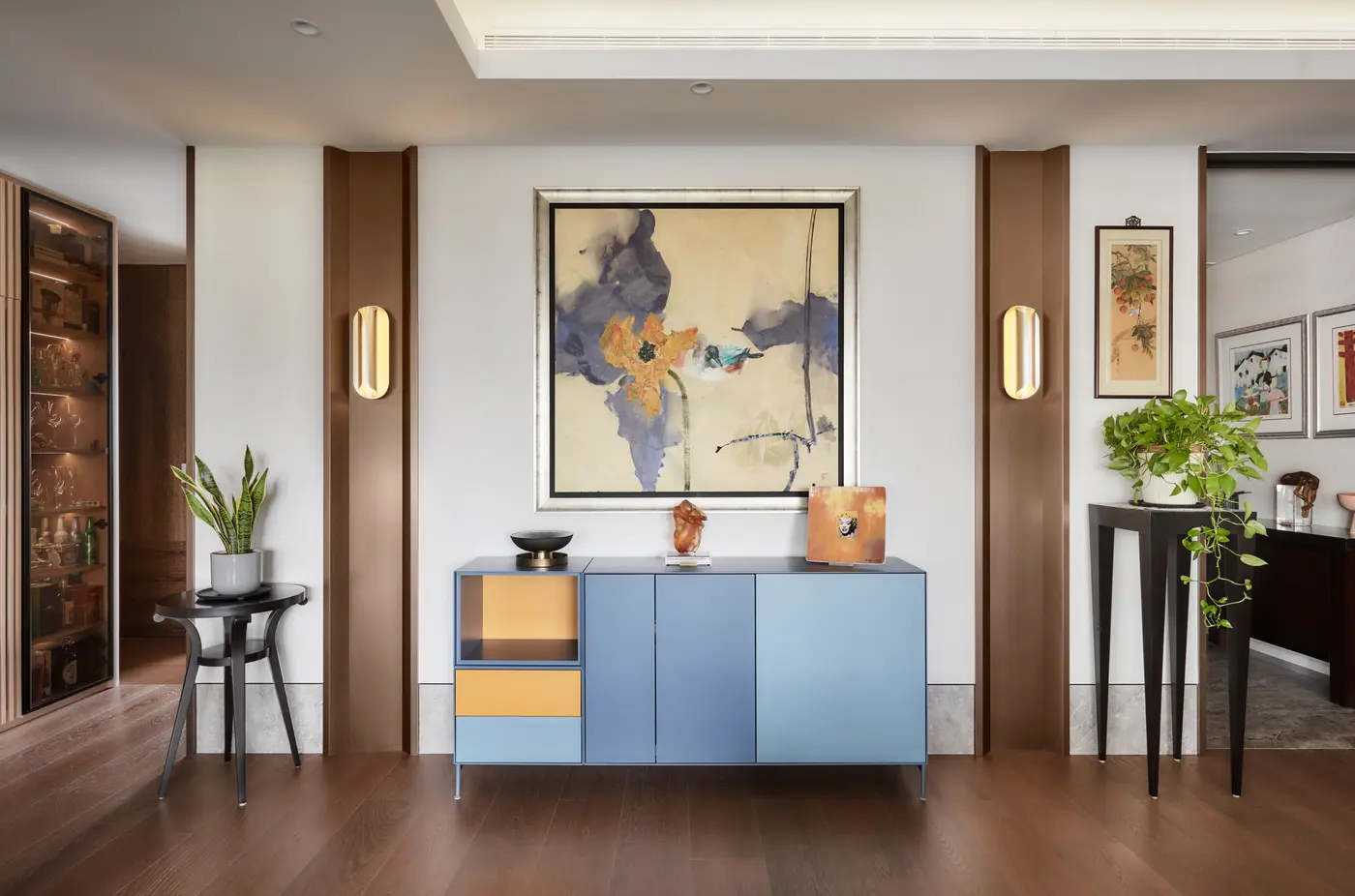
The foyer anchored by a Feng Shao Hua painting and the blue-and-yellow Treku sideboard — the palette born from the couple's favourite artwork.
The starting point for the entire interior was a painting. Not a painting chosen for the renovation — a painting the clients had owned and loved for years, a work by the renowned Chinese artist Feng Shao Hua, whose fluid brushwork draws blue and yellow into a luminous tension. These were also, as it happened, the couple's personal colours: blue for the husband, yellow for the wife. IDesignerLab took this as a directive.
Blue and yellow entered the home not as an accent scheme but as a genuine design language. The Treku TV console and sideboard carry the pairing with understated confidence, their matte surfaces reading as furniture when you first glance at them and as colour statements the longer you look. The PH 5 pendant by Poul Henningsen for Louis Poulsen hangs over the dining table, its concentric layers glowing — and somewhere in those layers, if you look carefully, lives the same blue that the painting holds. The Flowerpot VP1 by Verner Panton for &Tradition appears elsewhere, its dome a punctuation mark, warm yellow against the calmer surfaces around it.
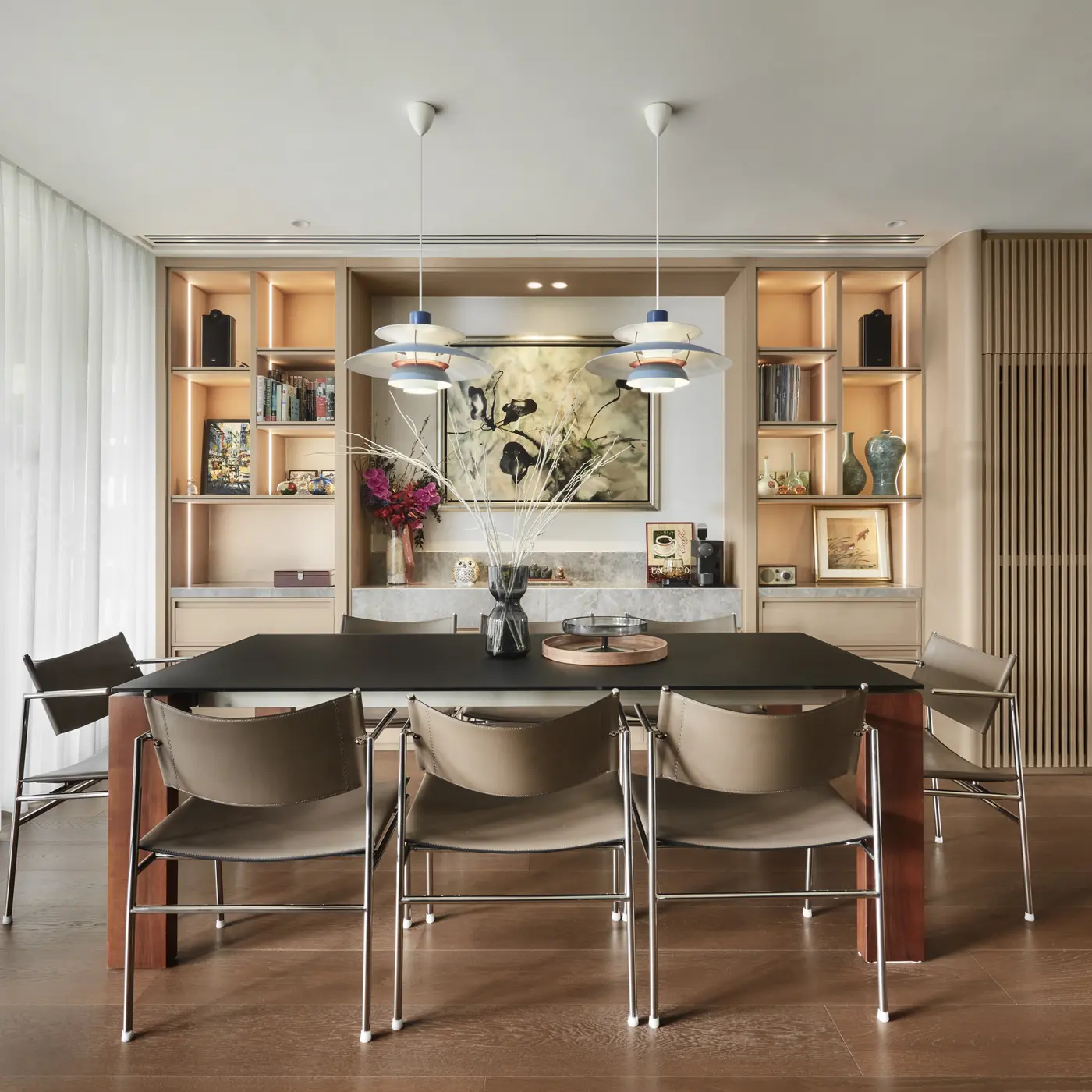
The dining room — the emotional heart of the home. The PH 5 pendants by Poul Henningsen float above a display wall that frames a second Feng Shao Hua painting.
The architectural palette around these moments is intentionally neutral — light wood laminates for the bespoke carpentry, their tone chosen to sit gently against the existing walnut timber flooring rather than compete with it. The lighter laminate brightens and lifts without erasing the warmth of the darker floor beneath. It is a decision of restraint that makes the colour accents possible. Without a quiet backdrop, the blue and yellow would have nowhere to breathe.
"Luxury should feel personal and timeless rather than trend-driven."
IDesignerLabWhat emerges from this palette is something that mid-century design has always understood: that colour, applied with discipline and grounded in meaning, does not date. It deepens.
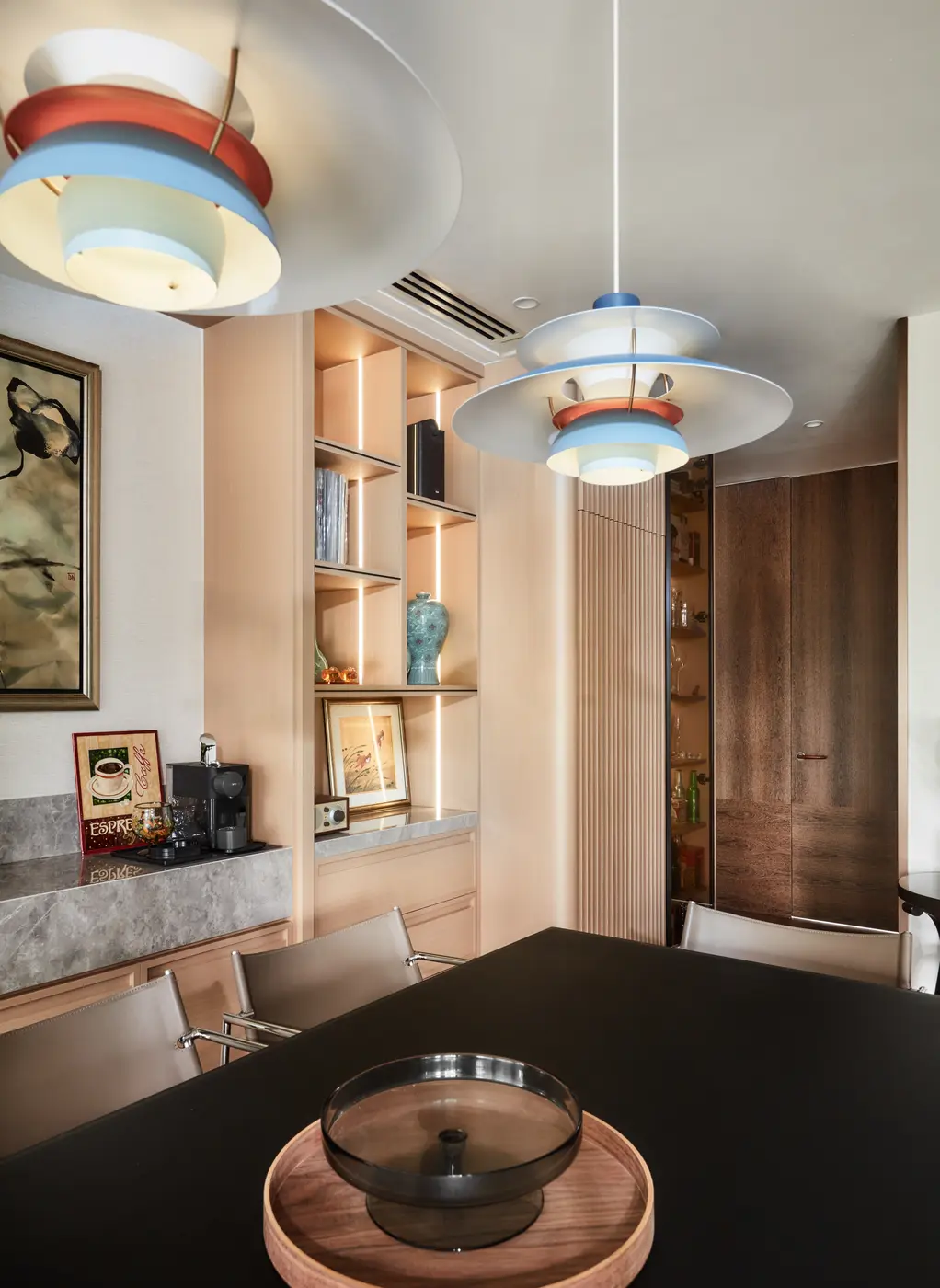
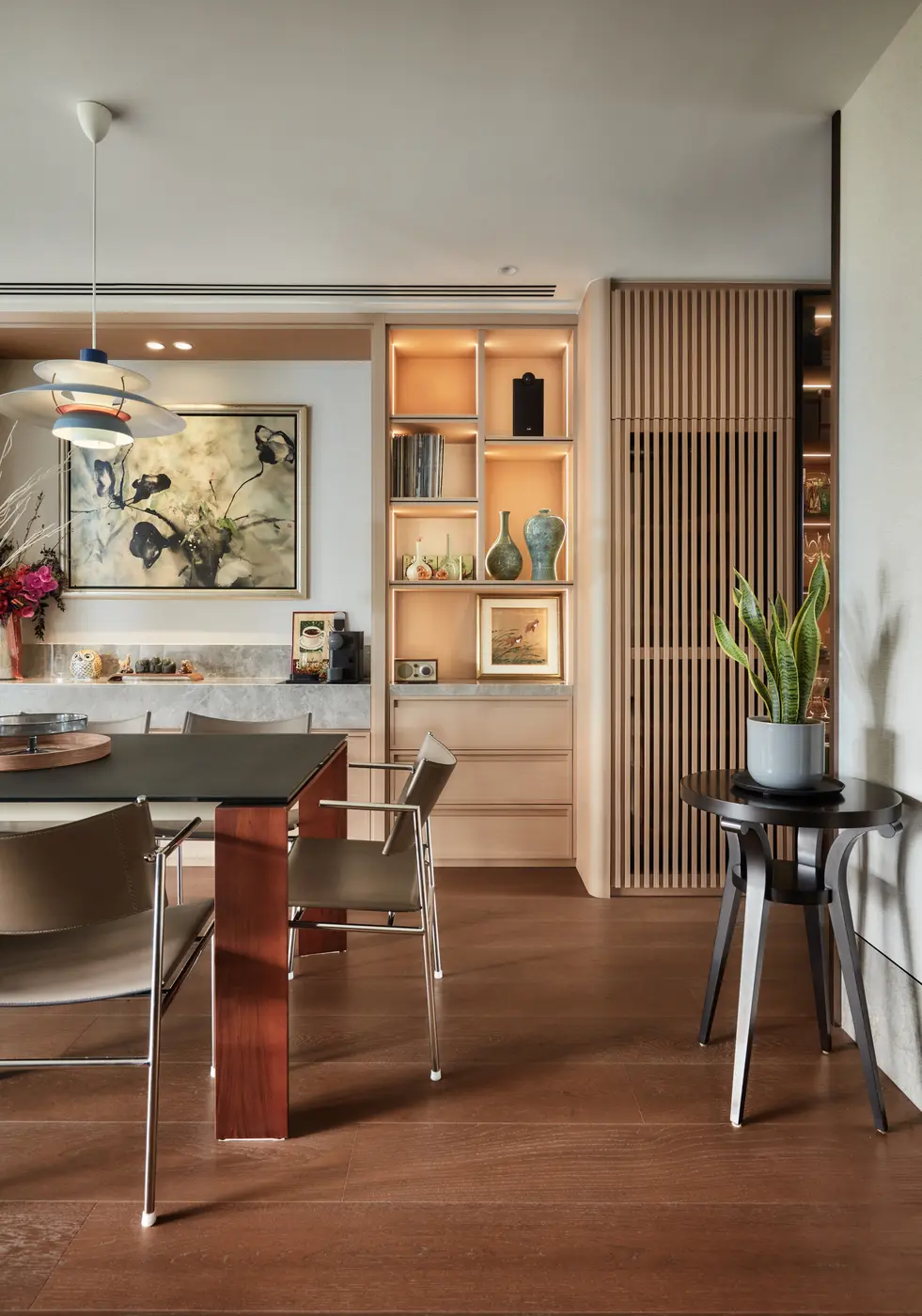
The iconic PH 5 pendants in blue reflect the husband's favourite colour, while the bespoke shelving wall — with yellow FENIX laminate inserts — carries the wife's.
IDesignerLab has a recurring gesture in their work: the frame. Not the kind that hangs on a wall, but the kind that is built into the architecture itself. In this home, frames appear around the television feature and around curated artworks, elevating functional objects into considered focal points. The gesture says: look here. This matters. It is a quiet insistence that the everyday be treated with the seriousness it deserves.
Equally present is the angled form. A slanted false ceiling in the living area became the genesis of a bespoke metal vertical screen, its slant carried downward into the room, integrated with carefully positioned wall lights. The screen does not divide the space so much as articulate it — introducing a dynamic architectural tension between the geometry of mid-century design and the restrained sophistication of contemporary living that the brief called for.
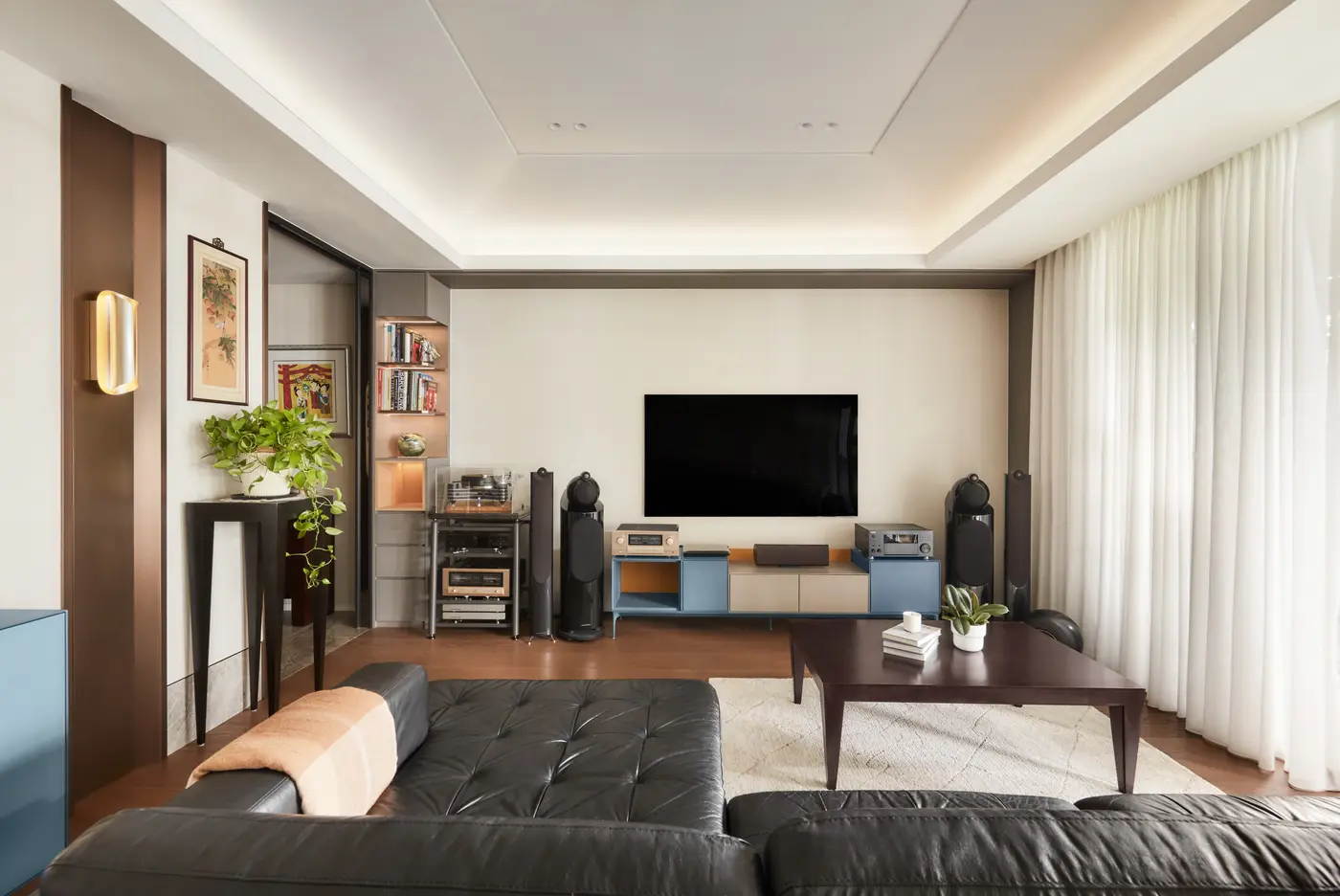
The living room, where existing leather sofas and the Treku AV console create a mid-century dialogue across the warm walnut floor.
In the master bedroom, the defining element is a curved headboard whose silhouette was drawn from the Singapore Airlines Business Class cabin — an enveloping form that wraps the sleeping space in a sense of shelter and privacy. The curve is not decorative. It is architectural, creating the sense of a room within a room, a cocoon that has its own atmosphere distinct from the rest of the home.
Flanking the headboard, two Flowerpot pendants hang on golden cords, their warm domes casting a specific quality of light — the kind that makes a room feel inhabited rather than staged. The surrounding panels, in their layered textures of dark timber and woven fabric, absorb rather than reflect, turning the sleeping zone into something genuinely still.
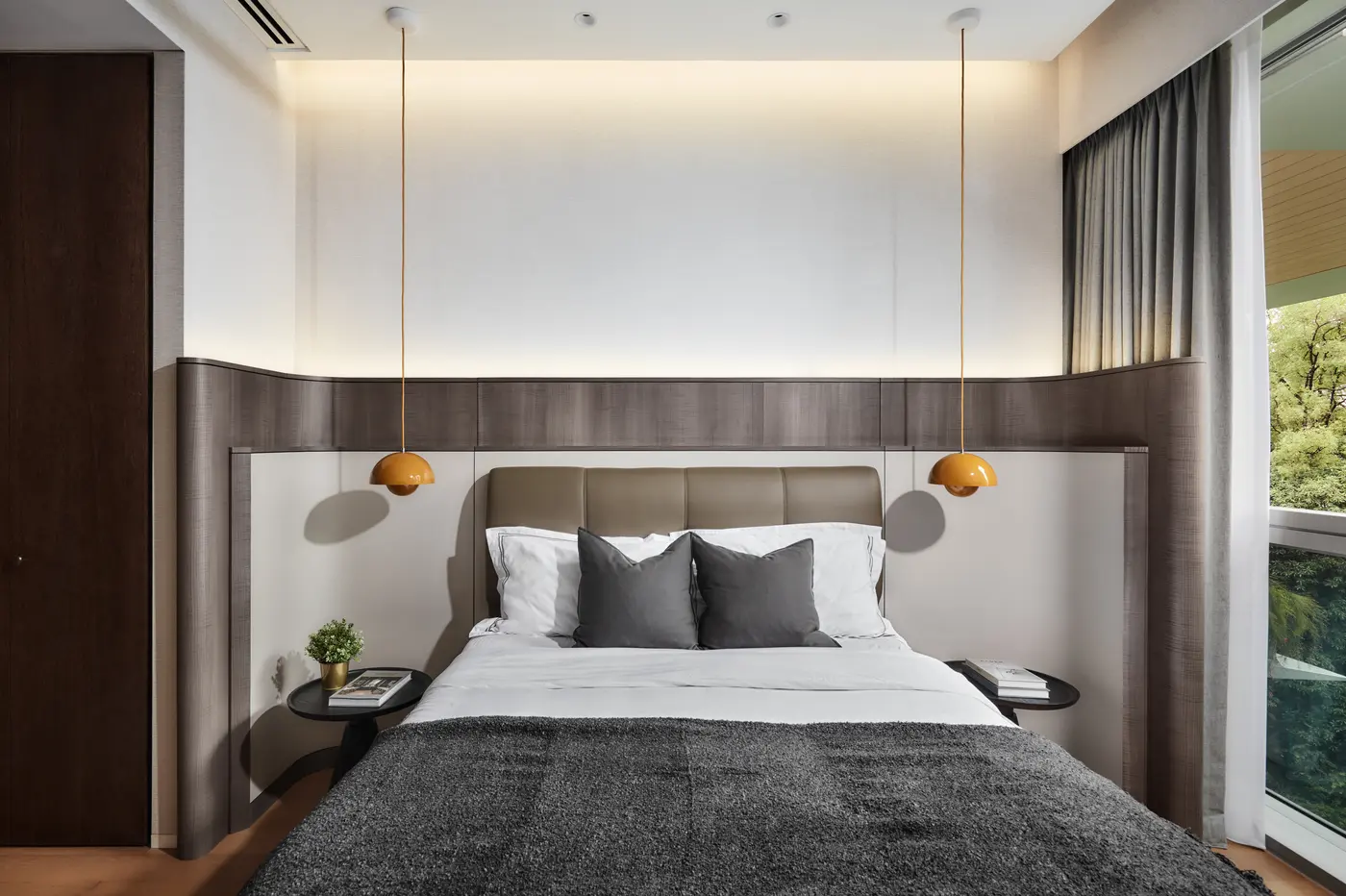
The master bedroom in full — the curved headboard inspired by the Singapore Airlines Business Class cabin, flanked by Flowerpot VP1 pendants by Verner Panton.
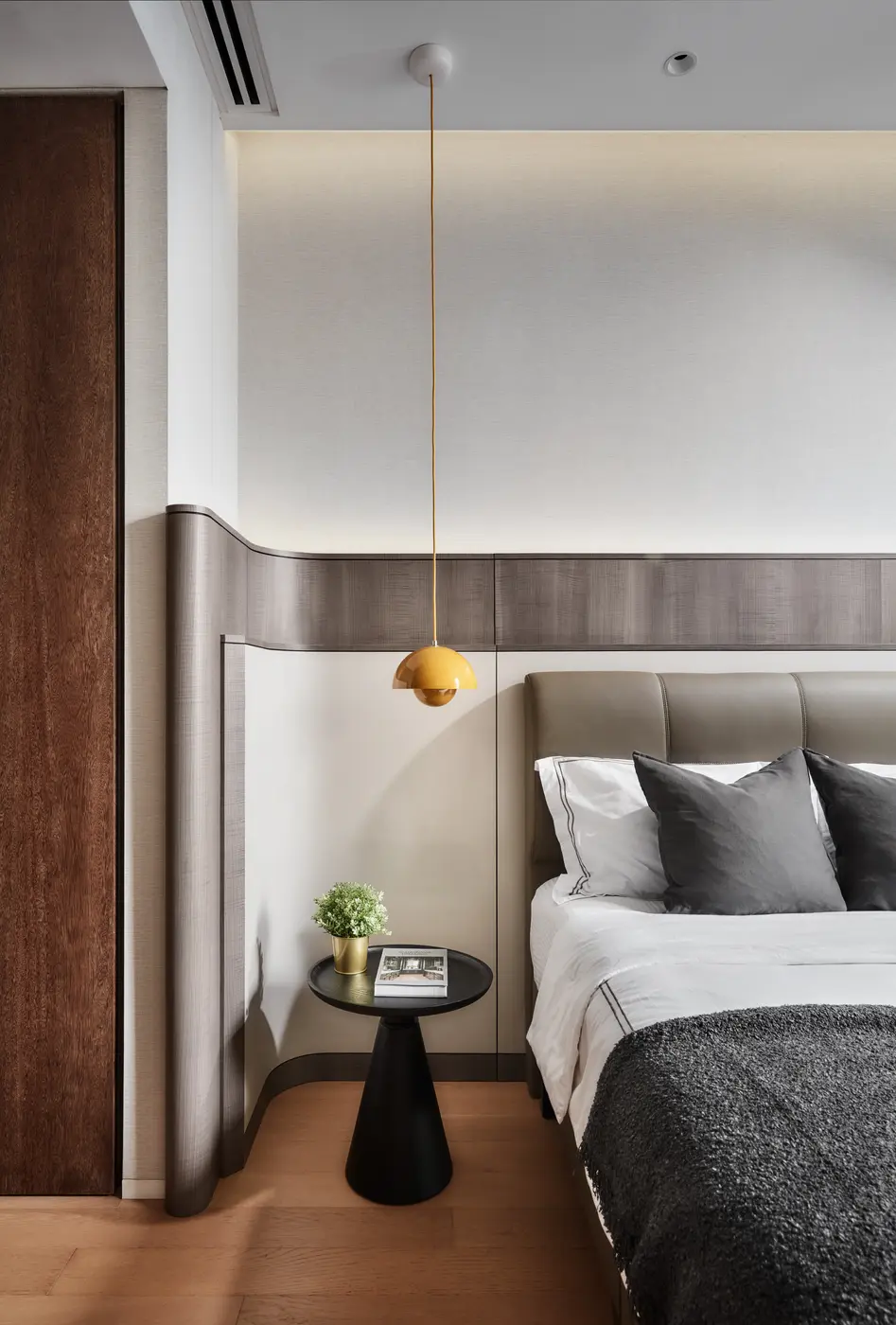
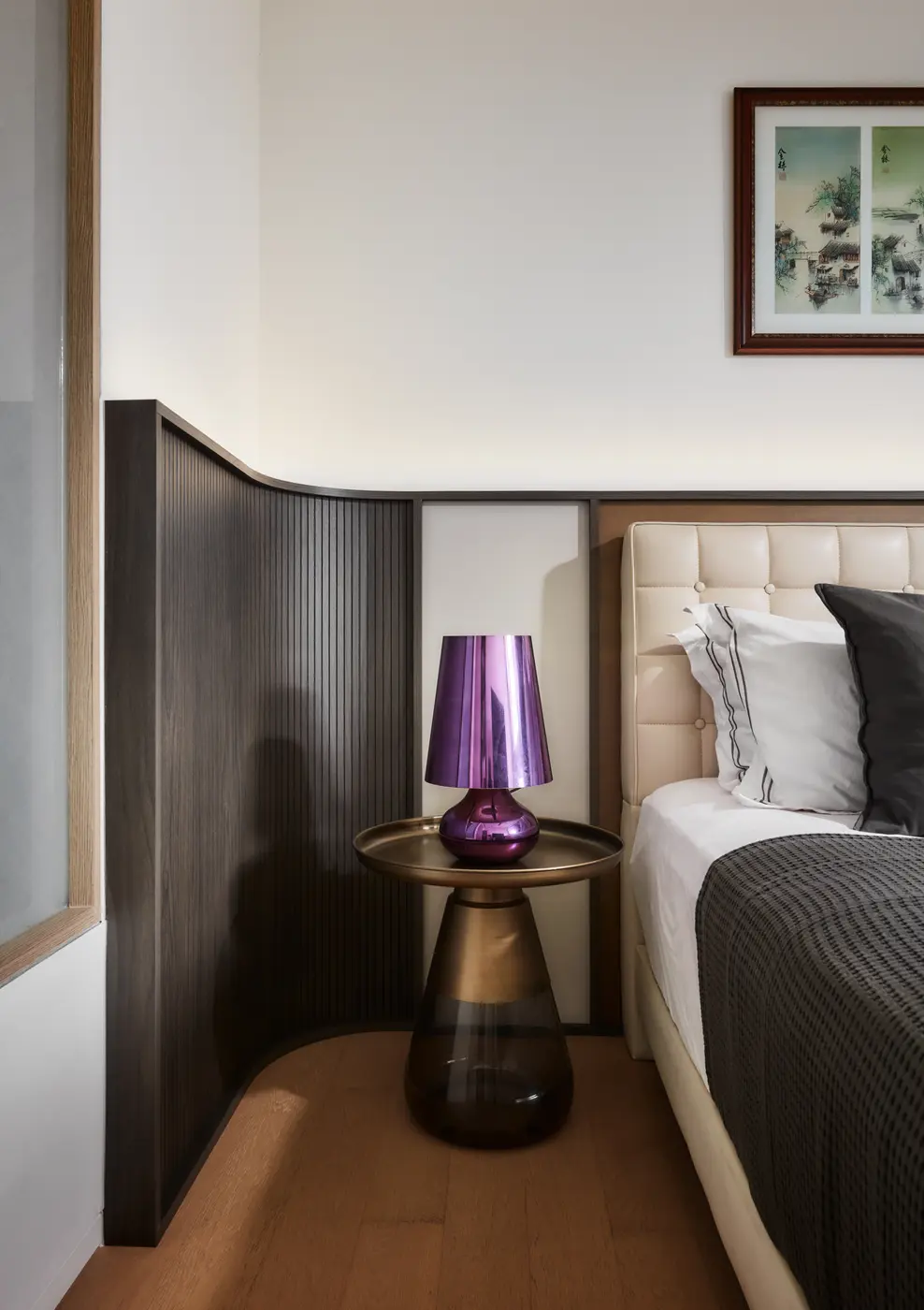
Left: the master bedroom bedside — the Flowerpot VP1 pendant by Verner Panton hanging over a black side table, plant and coffee table book. Right: the Kartell Bourgie lamp by Ferruccio Laviani, its metallic dome catching the curved timber panel behind it.
Ask IDesignerLab which part of this project is their favourite and the answer is immediate: the dining room. Not because it is the most visually striking — though it is — but because it is the space that most completely holds the soul of the brief.
The dining room is anchored by a bespoke wall of display and storage that wraps around a second Feng Shao Hua painting, transforming the artwork into a centrepiece rather than a decoration. The shelving that flanks it is layered with different backing materials — textured wallpaper in some cells, vibrant yellow FENIX laminate in others — creating a composition that is simultaneously composed and alive, curated and personal.
The existing dining table and chairs — client pieces retained and integrated — sit beneath the PH 5 pendants as though they were always meant to be here. And perhaps that is the deeper achievement of this project: making the retained feel chosen, making the familiar feel considered, making the inherited feel designed.
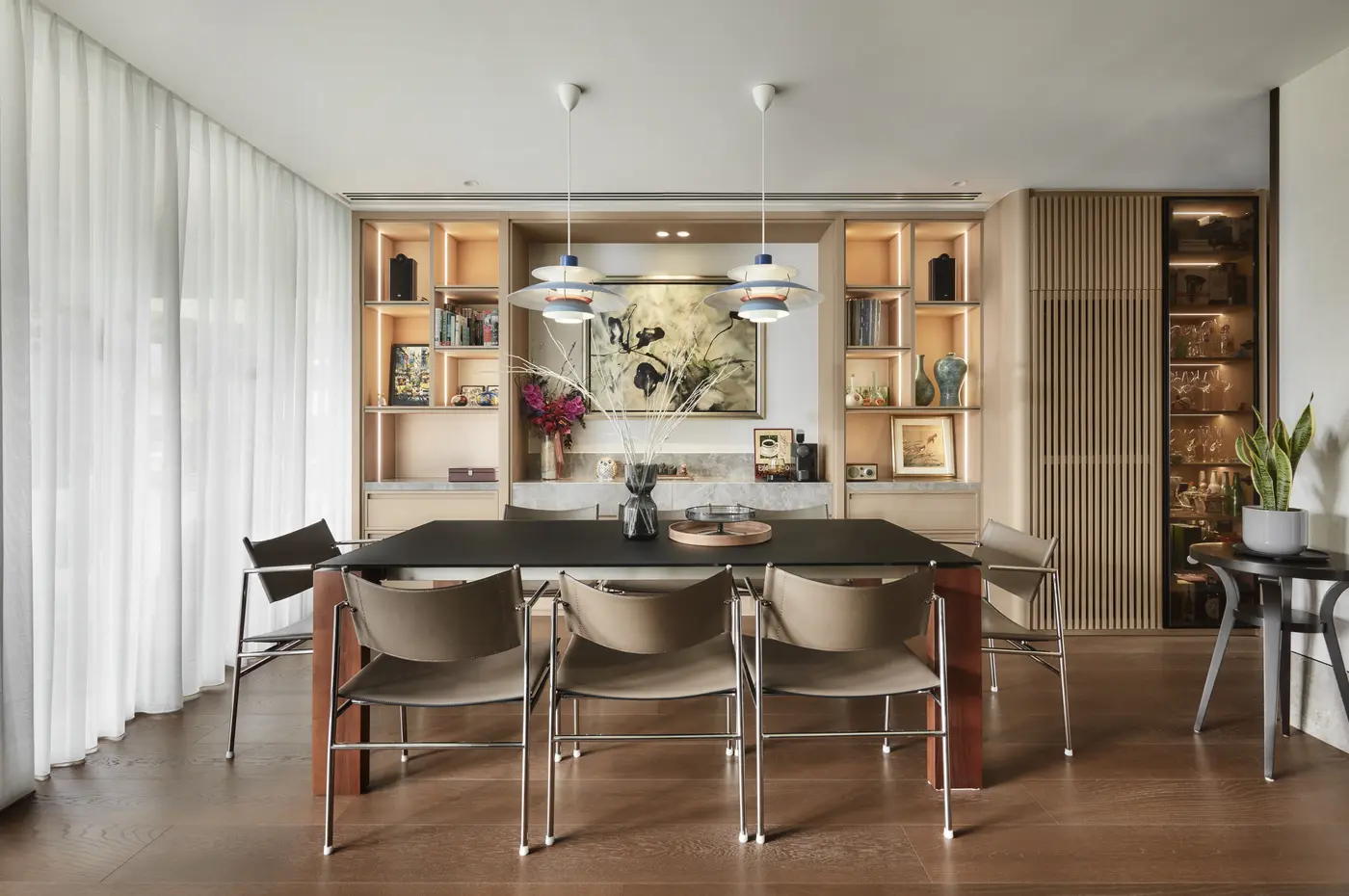
The dining room in full — the emotional and visual centre of the home, where art, colour, and memory converge around a table shared.
One of the more quietly radical aspects of this project is what IDesignerLab chose not to replace. The sofa, the dining table and chairs, the bedframe, the solid wood sideboard, the artworks, the television, the sound system, the lighting pieces — all were retained, reimagined within the new material composition rather than discarded. It is a form of sustainability that goes beyond calculation: it is a recognition that objects carry memory, and that designing around memory produces something that no new object can replicate.
The approach also reflects a position on luxury that is becoming increasingly relevant. True luxury, as IDesignerLab practises it, is not the act of replacing — it is the discipline of curating. The skill lies in knowing what to keep, how to honour it, and how to build something new around it that elevates rather than diminishes. Every client who lives in a home like this understands, eventually, that the meaning of the space is inseparable from its things.
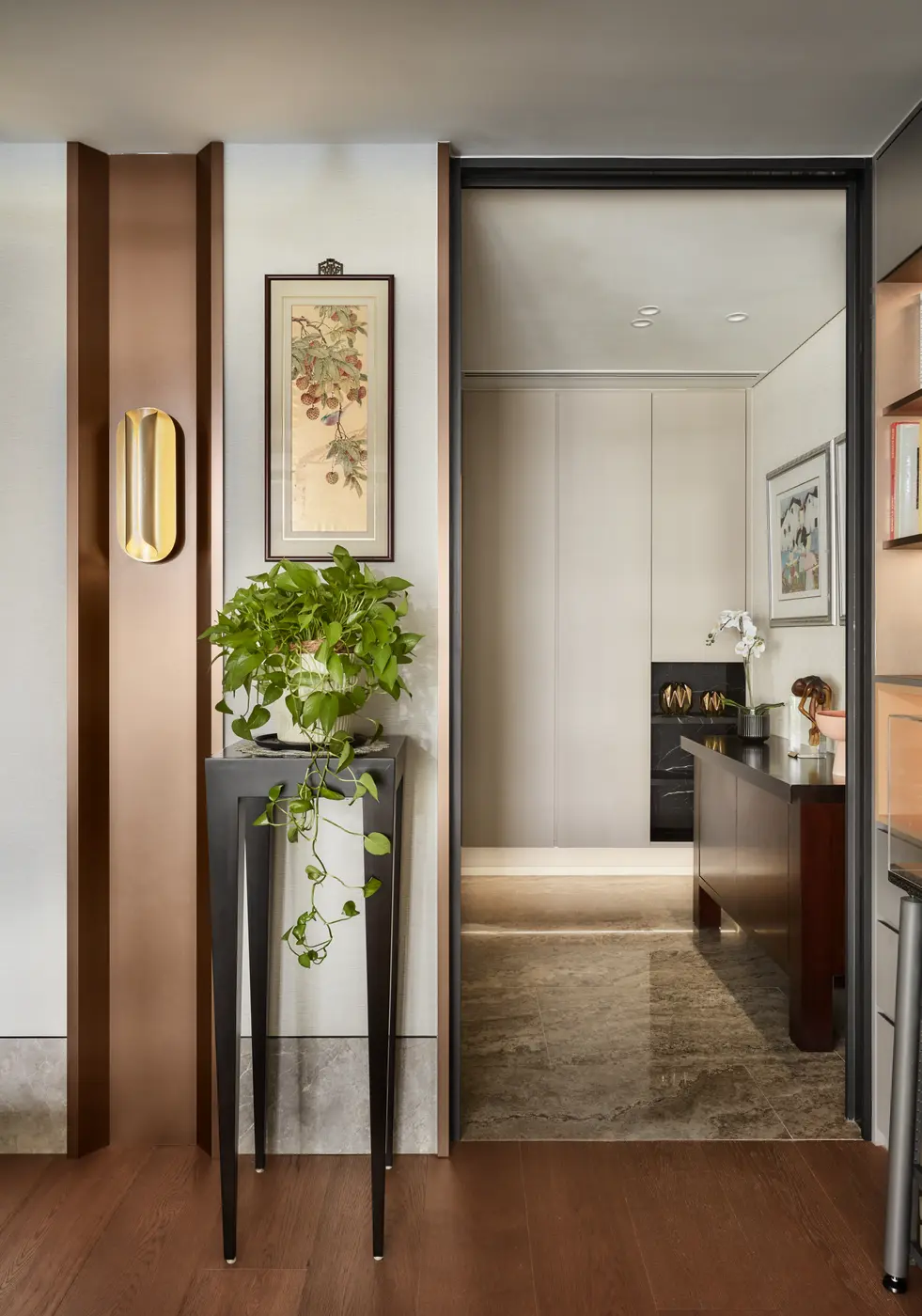
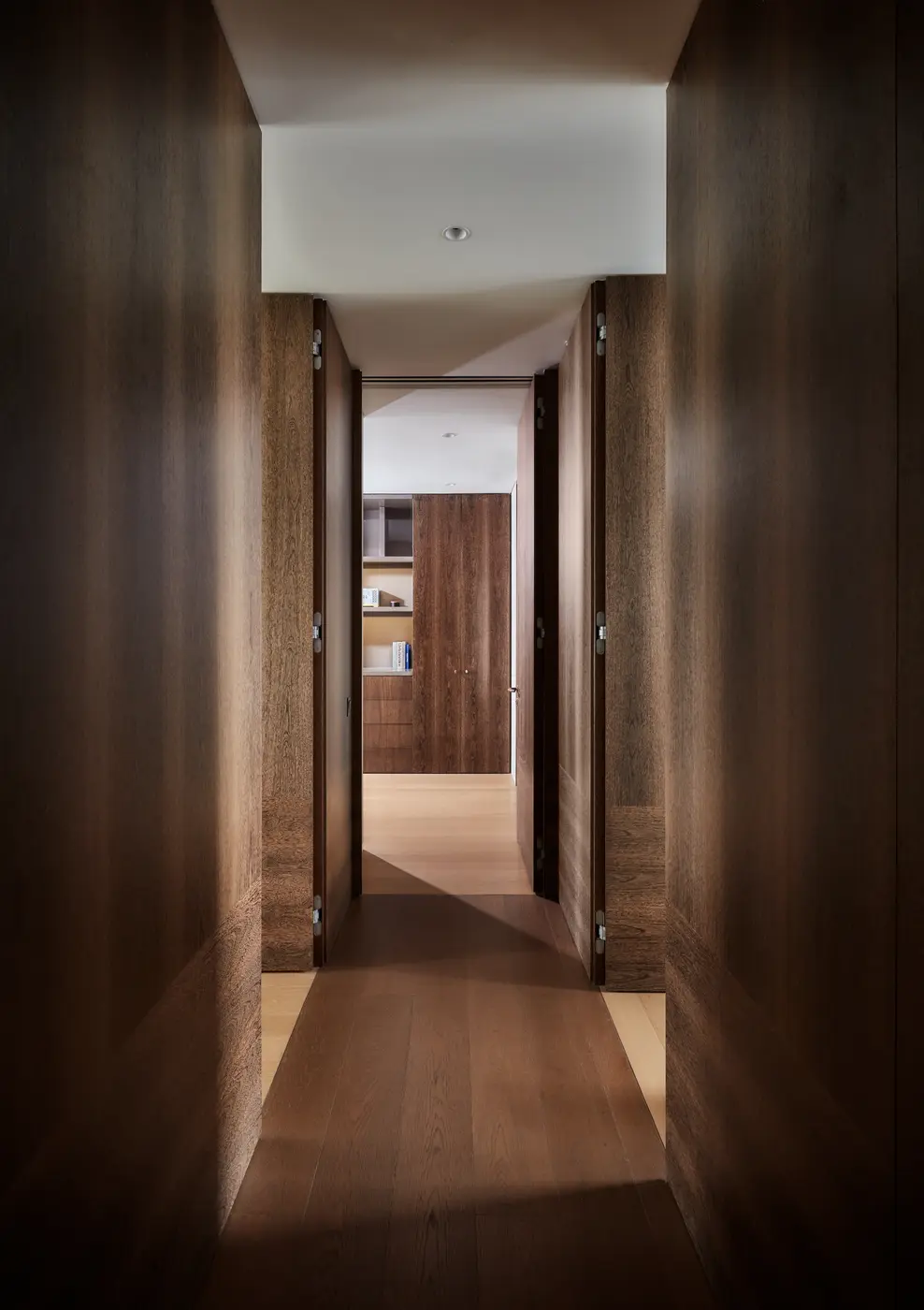
The entry passage (left) and the private corridor (right) — both lined with dark timber that establishes a sense of arrival and intentional transition between the social and private zones of the home.
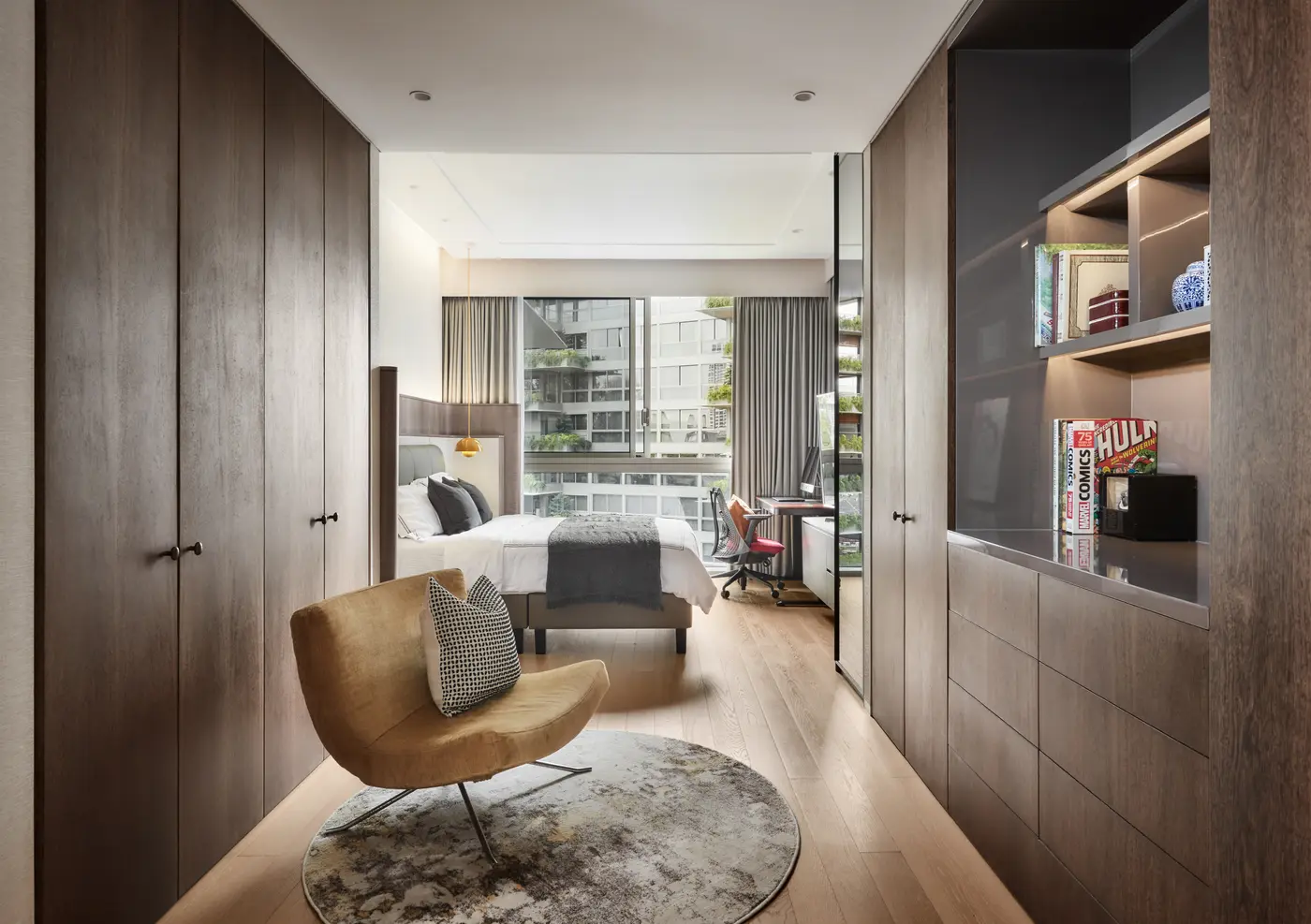
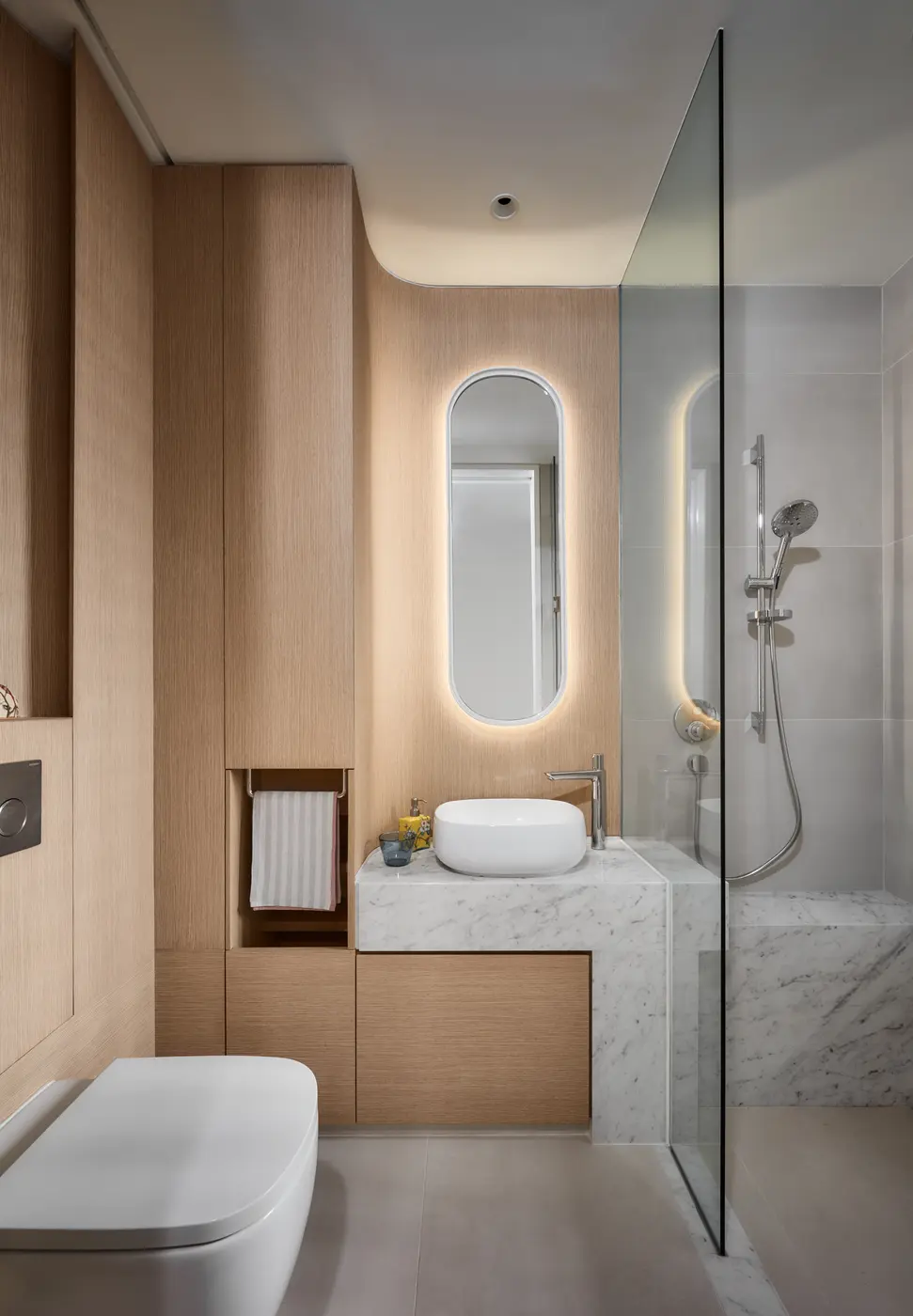
Left: the secondary bedroom, where full-height wardrobes and a generous reading chair give the room a considered self-sufficiency. Right: the bathroom — Carrara marble, warm timber, and a backlit oval mirror that softens without dramatising.